
Pakistan's Late Withdrawal Leaves the Commonwealth Kabaddi Championship Hollow: The Journey from 14 Teams to 13, and the Question Nobody Answered
राष्ट्रमंडल कबड्डी चैंपियनशिप 2026 (23-31 अक्टूबर, वीर सावरकर स्पोर्ट्स कॉम्प्लेक्स, अहमदाबाद) से पाकिस्तान ने देर से अपना नामांकन वापस ले लिया, जिससे 14 टीमों का पुरुष मैदान 13 का रह गया। वापसी का कारण किसी भी उपलब्ध रिपोर्ट या आधिकारिक बयान में नहीं बताया गया है। ईरान और चीनी ताइपे भी इस आयोजन में नहीं उतर रहे हैं। टूर्नामेंट का यह पहला संस्करण है और इसकी स्वीकृति देने वाली संस्था का खुलासा नहीं हुआ है, इसलिए इसकी प्रतिष्ठा को एशियाई खेलों या कबड्डी विश्व कप के बराबर नहीं माना जा सकता। पृष्ठभूमि में एशियाई खेल 2026 में भारत ने पुरुष और महिला दोनों वर्गों में स्वर्ण जीता, जबकि पाकिस्तान सेमीफाइनल में नहीं पहुंचा और उसके हाथ कोई पदक नहीं लगा। रिपोर्ट में कोई खिलाड़ी नाम, स्क्वाड, आंकड़ा या हार-जीत का तकनीकी विवरण नहीं दिया गया है, इसलिए पाकिस्तान के पतन की कोई भी तकनीकी व्याख्या अनुमान है, सत्यापित तथ्य नहीं। सबसे अधिक संभावित संरचनात्मक व्याख्या यह है कि पाकिस्तान का घरेलू तंत्र सर्कल स्टाइल पर आधारित है जबकि अंतरराष्ट्रीय कबड्डी स्टैंडर्ड स्टाइल में खेली जाती है — दोनों में डू-ऑर-डाई रेड, बोनस लाइन और लो एंकल-होल्ड रक्षा के स्तर पर बड़ी तकनीकी दरार है। पुष्टि के लिए आवश्यक: पाकिस्तान कबड्डी महासंघ का आधिकारिक बयान, आयोजन की स्वीकृति देने वाली संस्था का नाम, स्क्वाड सूचियां और मैच आंकड़े।
International kabaddi's calendar has thinned out over the past several years, and its politics has thickened in exact proportion. 2026 is a year of two major events for the sport — the Asian Games first, and the Commonwealth Kabaddi Championship second. Now comes the story attached to that second event which has put a question mark over the tournament's own standing: Pakistan has withdrawn its entry, and a field of 14 teams has become a field of 13.
The first thing that must be said is also the weakest part of this story, and it should be placed at the very top. The available report does not state why Pakistan withdrew. There is no official statement, no named official, no federation press note. What exists in the public domain, as of now, is a single fact — Pakistan will not play — and behind that fact is an empty space. From a journalistic standpoint this is an uncomfortable position, because the most important part of the story, the 'why', is currently unavailable.
The shape of the tournament
The Commonwealth Kabaddi Championship 2026 is scheduled for 23 to 31 October at the Veer Savarkar Sports Complex in Ahmedabad. It is described as the second major kabaddi event of the calendar year — the Asian Games being the first. A men's draw of 14 nations was announced initially. After Pakistan's late withdrawal, that number stands at 13. Iran and Chinese Taipei are also not participating.
One clarification is essential here, because it determines the direction of the entire analysis: the report never states which rule code the championship will be played under. Two systems dominate kabaddi — Standard Style and Circle Style — and technically they are close to two different sports. The venue is Ahmedabad, India's Standard Style heartland, and the event is being framed against the Asian Games, so it is reasonable to assume Standard Style. But that is an inference, not a confirmation. Had this been a Circle Style event, the meaning of Pakistan's withdrawal would change entirely.
Pakistan's withdrawal: what was reported, and what was not
The fact is plain. Pakistan was included in the initial list of 14 teams and later pulled out. The decision appears to have come late, since the announcement had already been made. In the kabaddi domain, last-minute national-team withdrawals have far more often been administrative — clearance, visas, delayed funding release, travel permission — than competitive. That is a general observation, not a claim about this particular case.
One further detail makes this withdrawal unusual: Pakistan has travelled to Ahmedabad for kabaddi competition before — the 2026 Kabaddi World Cup was staged there and included a Pakistani team. That weakens the simple explanation of host-country security or atmosphere. Something else has changed. What changed is not currently in the public record.
The right way to read this story, therefore, is to keep three possible clusters of causes separate and label all three explicitly as inference:
First, administrative or political causes. Uncertainty around any sporting tour between the two countries is not new. But confirming this would require an official statement that does not yet exist.
Second, logistical and financial causes. Visa delays, travel permits, delayed federation funding — these routinely knock teams out in the final week and have nothing to do with playing strength.
Third, competitive causes. This is the option that receives the least attention and rewards the most analysis. Which is precisely why it is the most interesting inference of the three.
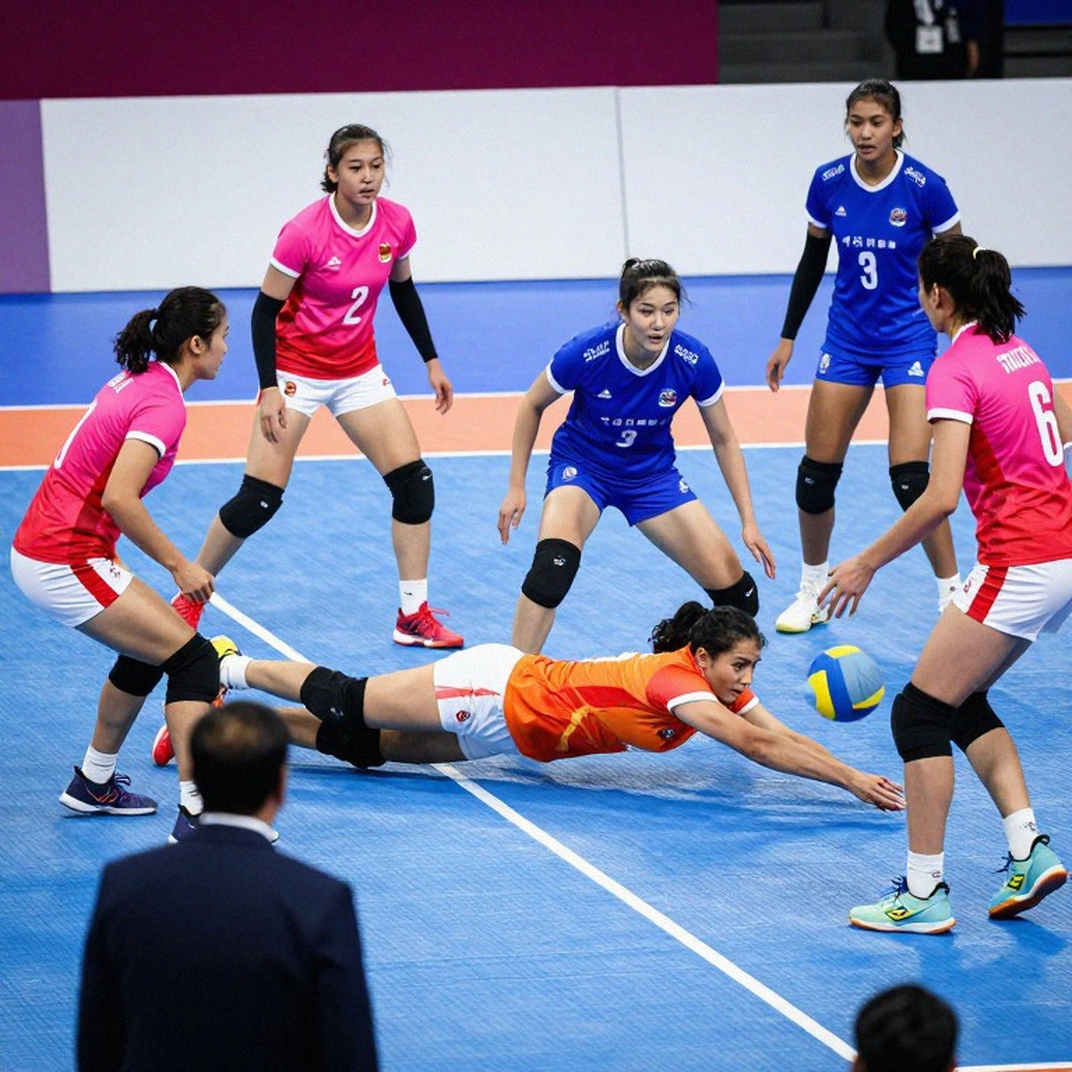
The Asian Games truth: a blank medal column
The part of this story that matters most is not Pakistan's withdrawal but what preceded it. According to the report, Pakistan failed to reach the semi-finals of kabaddi at the Asian Games 2026 and won no medal. There is also a claim that this is the first time Pakistan has failed to secure at least a bronze in kabaddi.
That second claim needs careful handling. Pakistan has featured on the Asian Games kabaddi podium at bronze and silver level in earlier cycles. The 'first ever blank' claim must be checked against Olympic Council of Asia records. It may be inaccurate, or it may be a translation of something more precise, such as the first break in an unbroken medal streak. For now it should be treated as unverified.
But the core point — no medal — if accurate, is not the story of one bad tournament. It points to a structural problem, and that problem is technical.
Standard Style versus Circle Style: the real technical divide
To understand kabaddi, one must first understand how different the two codes are. Standard Style is played on a rectangular court (13m × 10m) with seven players a side; it is the format used at the Asian Games and in Pro Kabaddi League. Circle Style is played on a circular field, commonly with eight players a side and simplified scoring, and it dominates rural Punjab on both sides of the India-Pakistan border.
Defensively the divide runs deeper still. Modern Standard Style defence rests on disciplined corner-cover and low ankle-holds. Circle Style tends to be dominated by upper-body strength and wrestling-style grappling. A team built on Circle Style inheritance is structurally disadvantaged in Standard Style.
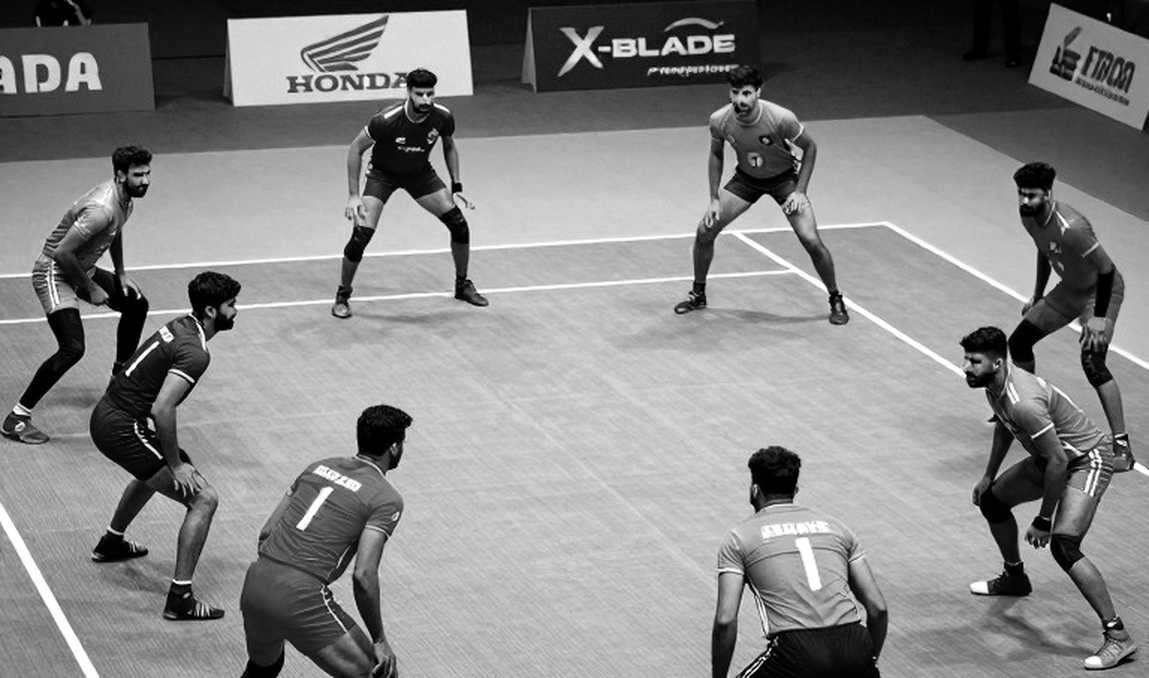
The second critical point is the Do-or-Die raid. Most Circle Style formats do not have it. There a raider can return without scoring. In Standard Style, after two empty raids the third becomes compulsory-scoring, or the raider himself is out. The direct consequence is that raiders raised in Circle Style can be masters of one-on-one evasion but see their success rate fall against the multi-defender structures of Standard Style. This is general sports analysis, not a claim about any particular player or the 2026 squad.
The third element is the Bonus Line. It is Standard Style's great tactical equaliser. Crossing a line drawn deep in the opponent's half earns one point, provided the defence has six or more players on court. This means a team sitting back in deep defence is punished by the bonus line itself. A side without a bonus-line raider is forced into low-percentage touch raids. Pakistan's recent Standard Style outings fit that profile exactly.
Understanding the rules: what kabaddi actually is
For readers unfamiliar with the sport's mechanics, three rules matter, because the entire analysis rests on them.
Raid: the attacker, or raider, enters the opponent's half, must touch at least one defender, and must return to his own half within 30 seconds. Throughout, he must continuously chant 'kabaddi, kabaddi' to prove he is not taking a breath. This cant rule makes kabaddi the only mainstream sport with a built-in breath clock. If the chant breaks, the raid is dead and the raider is out. That is why most raids do not last beyond 15 to 20 seconds.
Bonus and Super Tackle: crossing the bonus line earns one point. A tackle made when the defence has three or fewer players on court earns two points — a Super Tackle. It is the single most momentum-flipping rule in the sport; a three-man defence becomes lethal.
All Out: when every player on one side has been ruled out, the opponent gains two bonus points and the entire eliminated team is revived. This means a ninety-second collapse can erase a six-point lead. For weaker teams this variance cuts both ways — sometimes hope, sometimes catastrophe.
Total point values are small, so even a seven-point lead is not safe. That is why a deficit in Standard Style does not remain a mere 'form' problem; it becomes structural incapacity.
India: double gold, but one-sided
Meanwhile India won gold in both the men's and women's events at the Asian Games 2026. It is a remarkable achievement, but not a surprising one. India's kabaddi system is fully professionalised — PKL-trained players, data-driven coaching, and bench depth of more than twenty international-standard players. India's real advantage is not a single star raider but replaceability at every position.
Pakistan is the exact opposite. No PKL exposure, no overseas-club pathway, and a domestic circuit dominated by Circle Style. The national side therefore has no systematic mechanism for producing specialists at corner and cover — the two positions that decide modern matches. This is not a crisis of one skill; it is a crisis of the entire portfolio.
The report also states that Pakistan had a good opportunity to win a medal. That argument is tactically defensible, because Iran and Chinese Taipei are absent. But it has a flaw: a thinned field cuts both ways. If Iran is not there, India's dominance is also unopposed, and India is the one opponent Pakistan has not beaten in Standard Style competition in the modern era. The opportunity was large, but so was the biggest obstacle.
Iran and Chinese Taipei: an absence that does not show in the count
According to the report, Iran and Chinese Taipei are also not competing. On paper these are just two names. In reality they change the entire arithmetic of the tournament's quality.
International kabaddi's hierarchy is simple: India, then Iran, then everyone else. Iran is the only team that consistently challenges India in Standard Style. And here is the irony — Iran is not a Commonwealth nation. The tournament's structure is therefore such that it cannot contain the one team capable of beating India. This is not coincidence; it is a design flaw.
Chinese Taipei's absence may matter more in the women's draw than the men's, because Chinese Taipei's women's programme has been a genuine Asian Games medallist. Its absence alongside Iran's suggests Asian federations are treating this event as a low-priority, non-ranking fixture.
What 13 teams actually means
The real question is not the change from 14 to 13. The real question is what 13 means. If Iran, Chinese Taipei and Pakistan are all out, the effective competition is India plus a group of nations for whom a semi-final is the realistic ceiling. Thirteen teams can be numerically large and competitively tiny.
The second point is the background: the report itself concedes that international kabaddi competitions are limited. That yields a hard conclusion. When there are only two major events a year, missing even one means losing a very large share of a national programme's development year. For Pakistan this is not the loss of one championship; it is close to a year of international exposure reduced to zero.

The tournament's prestige: an uncomfortable truth
The story carries an implicit premise — that this is a 'major international event'. That premise deserves scepticism. This is an inaugural edition, so its prestige is not yet established. It is not stated under whose authority the event is being held — the International Kabaddi Federation, some Commonwealth kabaddi body, or a national federation acting on its own. That single fact determines whether the title counts. And the field has already been thinned by three significant absentees.
South Asian media has a habit of labelling inaugural, weakly sanctioned, field-depleted events as 'major'. Until the sanctioning authority is clear, this title cannot be ranked alongside the Asian Games or the Kabaddi World Cup.
There is also a practical obstacle: the 23 to 31 October dates. Pro Kabaddi League's traditional broadcast window runs October to December. If that window holds this year, a direct conflict arises, and it will be interesting to see whether India fields a first-choice squad or one rested from PKL duty. This is an inference, not confirmation, since the PKL calendar is not mentioned in the report.
What the withdrawal means for Pakistan
If the third cluster of causes — the competitive one — is even partly correct, then Pakistan's withdrawal can be called partly rational rather than merely political. A team that has just broken its medal streak at the Asian Games is entering a field it cannot beat, in a format it does not master, in a country where its historical record is mixed.
But a serious professional objection must be recorded here. The cure for a national programme is never to avoid competition. The only way to fix deficiencies at corner and cover is to play high-level matches. If there are only two international events a year and one is skipped, the room for improvement becomes zero. It is a vicious circle: weak performance means fewer opportunities; fewer opportunities mean weaker performance.
The second objection concerns the loss from Pakistan's absence being more commercial than sporting. Iran's absence lowers the standard. Pakistan's absence removes the one fixture with the greatest emotional and broadcast value — India versus Pakistan. In any sport that pairing is the biggest magnet for viewers, advertisers and new audiences. Failing to stage your biggest match in your inaugural edition is damage that does not show on the scoreboard.
What the report does not contain
For transparency, it is necessary to list what is missing from this report entirely.
There is not one statistic. No raid points, no successful raid percentage, no tackle success rate, no player names, no squad lists, no pool structure, no qualification method, no prize money, no list of women's entries.
The conclusion is direct and honest: from the sentence 'Pakistan did not reach the Asian Games semi-finals', no technical diagnosis can be drawn. It cannot be said whether raiding failed or the defence collapsed. Anyone asserting Pakistan's precise tactical weakness on that basis would be inventing an inference. Any technical analysis here is explicitly general sports reasoning, not reported fact.
Another gap: the men's field going from 14 to 13 is mentioned, but the women's draw is not mentioned at all. That suggests a separate women's draw whose composition has gone unexamined. Losing half the tournament in a report about the whole tournament is a significant omission.
Conclusion
This story has three layers, and they must be kept apart.
Layer one is fact: Pakistan will not play in the Commonwealth Kabaddi Championship 2026, the field has gone from 14 to 13, Iran and Chinese Taipei are also absent, and the event runs 23 to 31 October in Ahmedabad. That much is firm.
Layer two is inference: the reason for the withdrawal, the team's technical condition, the tournament's rule code, India's squad composition and the event's sanctioning — none of this is verified. A decisive claim on any of it would be premature.
Layer three is meaning, and it is the most durable. International kabaddi's real problem is not that one team is losing. It is that the sport has so few stages that every absence becomes structural damage. Keeping the India-Iran rivalry alive, giving programmes like Pakistan's a chance to develop, and allowing inaugural events to earn prestige — all three require more matches, not fewer. Pakistan's withdrawal is not merely one team's absence. It is one more instance of the shortage this sport already struggles with.
And through all of it, one thing stings most: why Pakistan withdrew is not known to anyone, at least publicly. Until an official explanation arrives, the question stays open. And for a sports journalist, admitting that the answer is unknown is always better than manufacturing a fake one.